
Duke University Cybersecurity Program Collaborates with CyberAlliance to Help Students Discover Cognitive Strengths and Navigate Cybersecurity Career Pathways

Durham, NC - March 4, 2026 - Duke University's Master of Engineering in Cybersecurity is collaborating with cybersecurity firm CyberAlliance to introduce a new approach designed to help graduate students better understand their cognitive strengths and how those strengths align with career pathways across the rapidly evolving cybersecurity profession.
The collaboration gives students in Duke's cybersecurity program access to Cyber Trust IQ, an advanced cyber aptitude assessment designed to evaluate the cognitive abilities associated with success in cybersecurity roles. By helping students understand how their natural problem-solving tendencies map to different cybersecurity functions, the assessment provides valuable insight into specialization paths, professional development priorities, and long-term career alignment.
This collaboration comes at a critical moment for the cybersecurity workforce. With more than four million cybersecurity positions currently unfilled worldwide, organizations across industries are struggling to identify and develop the talent required to defend digital infrastructure and critical systems.
While universities are producing highly skilled graduates, many students still face challenges determining where their unique strengths best fit within the wide spectrum of cybersecurity roles.
Through this collaboration, Duke students gain data driven insight into how their cognitive strengths align with the major domains of cybersecurity practice.
Cyber Trust IQ evaluates cognitive traits closely associated with cybersecurity performance, including analytical reasoning, pattern recognition, decision-making speed, and investigative persistence. Results are mapped across four primary cybersecurity career domains:
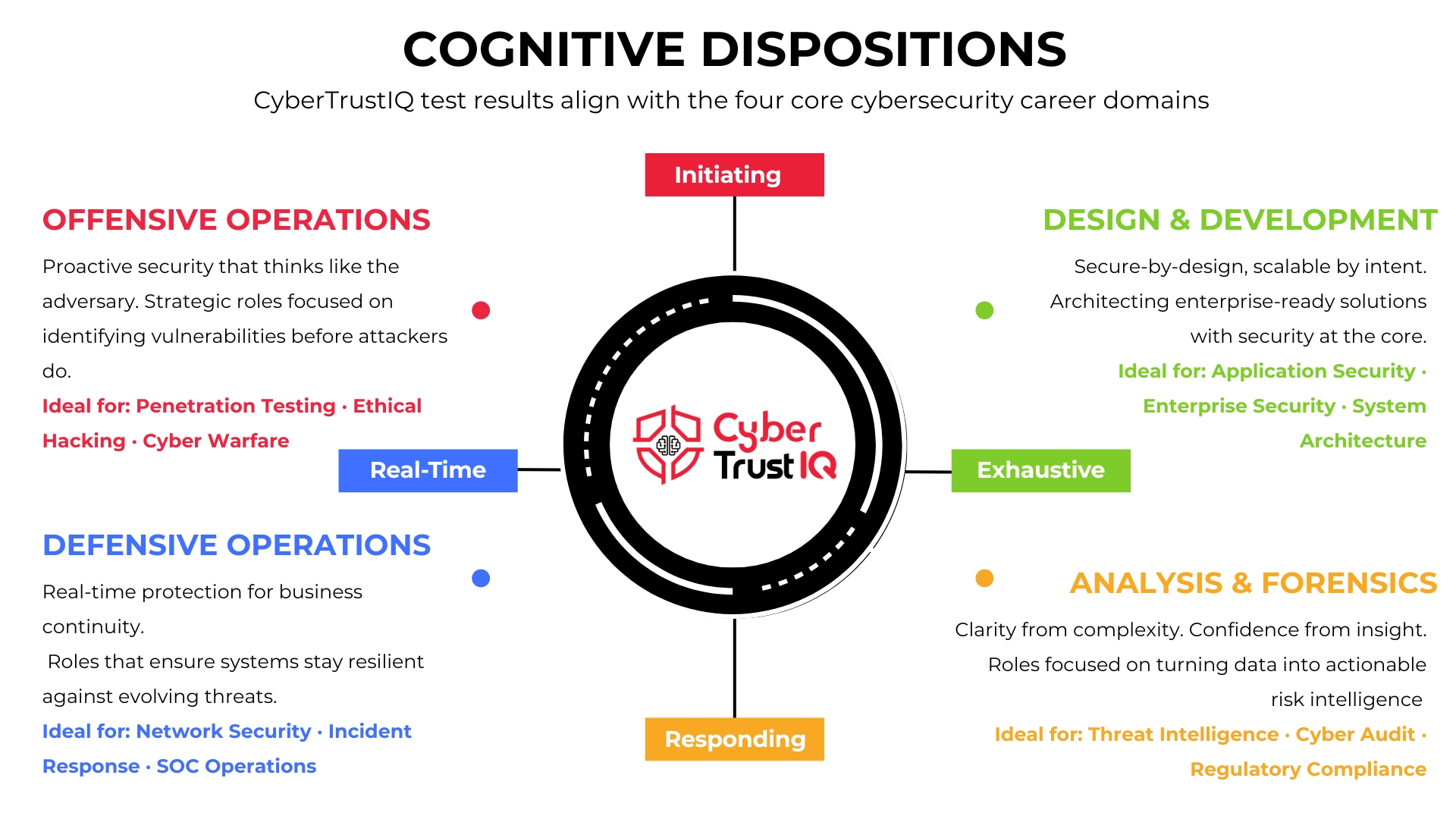
- Offensive Operations
- Defensive Operations
- Design & Development
- Analysis & Forensics
By helping students better understand how they approach complex technical challenges, the assessment provides a clearer view of which cybersecurity environments and roles may offer the strongest alignment with their abilities.
Unlike traditional evaluations that focus primarily on technical knowledge or certifications, Cyber Trust IQ measures innate cognitive aptitude, offering insight into how individuals think and solve problems. These capabilities often determine long-term success in cybersecurity roles. The assessment has demonstrated 97% accuracy in predicting cybersecurity job performance, based on validation across thousands of assessments.
For students, the insights can help guide decisions such as which technical pathways to pursue, which certifications to prioritize, and which cybersecurity environments, from security operations centers to threat intelligence or secure engineering, may best match their natural strengths.
For Duke University, the collaboration represents an opportunity to enhance the student experience by pairing rigorous academic training with tools that help translate skills and capabilities into real-world professional outcomes.
“Cybersecurity is an incredibly diverse field that requires different ways of thinking and solving problems,” said Art Ehuan, Executive Director of the Duke University Master of Engineering in Cybersecurity. “Helping students understand their cognitive strengths and how those strengths align with the wide range of cybersecurity roles can give them greater clarity as they develop their careers and enter the workforce.”
“Cybersecurity requires a wide range of cognitive approaches, from rapid response in defensive environments to deep analytical reasoning in threat investigation and engineering,” said Kendrall Felder, Co-Founder and CEO of CyberAlliance. “By helping students better understand how they naturally think and solve problems, we can help accelerate their ability to find the roles where they will have the greatest impact.”
The collaboration reflects a broader shift in cybersecurity workforce development toward identifying and nurturing talent based on cognitive potential rather than relying solely on traditional credentials or prior experience. By focusing on aptitude, tools like Cyber Trust IQ can also expand opportunities for individuals from diverse educational and professional backgrounds.
Cyber Trust IQ is part of the broader CyberAlliance platform ecosystem, which includes Sally AI, an artificial intelligence-driven cybersecurity intelligence platform designed to help organizations translate complex security signals into actionable risk insights and operational decisions.
As cybersecurity threats grow more sophisticated and the demand for skilled professionals continues to rise, educators and industry leaders alike are exploring new ways to better prepare students for the complexity of modern security roles. By combining rigorous academic training with data-driven insight into cognitive strengths, collaborations like this one are helping reshape the student experience in cybersecurity education, giving future security professionals greater clarity, confidence, and direction as they enter one of the most critical fields in the global economy.
About CyberAlliance
CyberAlliance is a cybersecurity and artificial intelligence company headquartered in Raleigh, North Carolina. The company develops advanced cybersecurity platforms and workforce intelligence tools designed to strengthen organizational cyber resilience. Its technologies include Sally AI, an AI-driven cybersecurity intelligence platform, and Cyber Trust IQ, a cognitive cyber aptitude assessment designed to identify and develop high-performing cybersecurity talent.
About Duke University's Master of Engineering in Cybersecurity
The Duke University Master of Engineering in Cybersecurity, offered through the Pratt School of Engineering, equips professionals to address the complex security challenges facing governments, enterprises, and critical infrastructure. The program integrates rigorous technical training with policy, leadership, and real-world applications, preparing students to secure digital systems, investigate cyber incidents, and build resilient security programs. Available online and on campus, it connects learners with industry, government, and defense partners who shape the future of the field.
Duke's national leadership is reflected in its recognition as the #1 online master's program in the country for 2024 by Fortune Magazine and its designation by the National Security Agency (NSA) as a National Center of Academic Excellence in Cyber Defense (NCAECD). These distinctions highlight Duke's commitment to advancing cybersecurity education, research, and workforce development.
Students and professionals also benefit from Duke's flagship annual event, the Cybersecurity at Duke Conference, which brings together global experts, practitioners, and thought leaders to explore emerging threats, resilience strategies, and the evolving cyber landscape. This conference provides students with direct access to the conversations and innovations shaping the industry.
Complementing the degree program, Duke's Executive Cybersecurity Programs prepare CISOs, senior leaders, and technical managers with forward-looking, interdisciplinary training to stay ahead of emerging threats, harness new technologies responsibly, and lead with confidence in an increasingly complex digital world.